
Number Bonds Challenge
Play a free number bonds game built around the same part-part-whole diagrams used in classrooms. Find the Partner shows a bond diagram with one blank circle — the whole, or either part — for you to fill in; Find the Pair shows only the target and asks you to tap two number bubbles that add up to it. Four levels move from bonds to 5 up through bonds to 100, with no sign-up and nothing saved.
Number Bonds Challenge uses the classic circle-and-branch bond diagram, not a plain equation in a box: the blank position (whole, first part, or second part) and the framing (a bare diagram, an addition sentence, or a subtraction sentence) both vary round to round, so the same target number is practiced from several angles rather than one repeated question shape.
Not a test — nothing is saved after you leave.
Ready to build some bonds?
Find the missing part of the bond, or tap two bubbles that add up to the target.
How to use the number bonds challenge
- 1Choose a level — it sets the bond targets (to 5, 10, 20, or 100).
- 2In Find the Partner, tap the number that completes the bond diagram's blank circle.
- 3In Find the Pair, tap two number bubbles that add up to the target shown.
- 4Keep your streak going across the round, then start a new one for a fresh set of bonds.
When this is useful
Part-part-whole number sense
Builds the foundational idea that a number can be split into two parts in more than one way.
Fact family practice
The same bond appears as an addition sentence in one round and a subtraction sentence in another, reinforcing how the two connect.
Kindergarten through grade 3 foundations
Levels move from bonds to 5 up through bonds to 100 as students are ready for bigger numbers.
Two genuinely different interactions
Find the Partner and Find the Pair test the same underlying skill from two different angles, not one repeated multiple-choice shape.
Classroom number-talk warm-up
Display a bond diagram and have the class discuss the missing part before revealing the answer.
Examples to try
Level 1: bonds to 5
The simplest bond diagrams, with no equation text — just the circles.
Level 3: bonds to 20
Adds subtraction-sentence framing alongside addition sentences and the plain diagram.
Level 4: bonds to 100
The widest target range, appropriate for grade 2-3 number sense work.
Tips for better results
Say the bond out loud
Reading the diagram as 'six and four make ten' before answering builds the same fluency the game is practicing.
Find the Pair rewards scanning, not guessing
Look for two bubbles that visibly add close to the target before tapping — only one pair is ever correct.
Subtraction framing is the same bond, read backwards
'10 − 6 = ?' and '6 + ? = 10' ask for the exact same missing part.
Move up a level once a target feels automatic
Higher levels widen the number range rather than changing the core skill.
How the number bonds challenge works
Every bond starts from a target ('the whole') split into two parts, then one piece of the diagram is hidden — the whole itself, or either part — so the same underlying fact can be practiced as three different missing-piece problems.
Find the Pair generates a pool of number bubbles that is checked to contain exactly one pair summing to the target, so there's never a second, accidentally-valid answer to tap.
Neither part of a bond is ever zero, so every round is a genuine two-part split rather than a trivial 'whole plus nothing'.
Private by design
- No account and no sign-up. Just open it and start.
- Everything runs on your device, which keeps the answers you choose private.
- Nothing you create is uploaded. No values, names, scores, or generated content are sent to our servers. If you're signed in, My Classeem's Recent Activity notes which tools you used — never what you did in them.
- We use Google Analytics for anonymous, aggregate measurement: page views and a few usage events, such as a worksheet being printed or a game round starting or finishing (with the mode played). It never receives what you enter — no answers, scores, names, or generated content.
Frequently asked questions
Is this number bonds game free?
Yes, completely free, with no account and no limit on how many rounds you play. There are no ads.
What levels are available?
Level 1 covers bonds to 5, Level 2 bonds to 10, Level 3 bonds to 20, and Level 4 bonds to 100.
What's the difference between the two modes?
Find the Partner shows a bond diagram with one blank circle to fill in. Find the Pair shows only the target and asks you to tap two bubbles that add up to it.
Will the same number bond repeat?
Some repetition of small targets is expected and useful for fluency, but the blank position, framing, and bubble choices vary, so the exact puzzle is usually different even for the same target.
Does this use AI?
No. Every bond, blank position, and bubble pool is generated by deterministic logic in your browser. It does not use AI.
Does the game work well on a tablet or phone?
Yes. The bond diagram and every button are sized for touch and adjust to narrower screens.
Are scores saved?
No. Your score, streak, and session best stay in your browser for the current session and are cleared when you leave the page.
More classroom tools
Number Bonds Worksheet Generator
Make printable number bond worksheets to 5, 10, 20, or 50 with circles or part-part-whole bars and an answer key.
Fact Family Worksheet Generator
Make printable fact family worksheets: addition and subtraction or multiplication and division, with answer key.
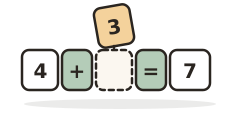
Math Equation Builder
A free math equation builder game: read a word problem, tap the numbers and operator that match it, then type the answer.
Always free · No account needed · Nothing you type leaves your device unless you choose to save it.